Late-Breaking Science Abstracts and Featured Science Abstracts From the American Heart Association’s Scientific Sessions 2023 and Late-Breaking Abstracts in Resuscitation Science From the Resuscitation Science Symposium 2023


FDA Greenlights Study Of Marijuana As PTSD-treatment For Vets
A federally approved clinical trial study will look at how cannabis use impacts post-traumatic stress disorder — and it's focused specifically on the veteran community.
The Multidisciplinary Association for Psychedelic Studies, MAPS, announced this month that it got through the final hurdles with the U.S. Food and Drug Administration to get approval for a clinical study to look at veterans' "real-world" cannabis use. The randomized, placebo-controlled study run will include 320 veterans who suffer from moderate to severe PTSD and have previously used cannabis to better understand the potential benefits and risks for treatment.
MAPS officials said the approval is a step forward towards normalizing studies on the drug, which already has widespread use medically and recreationally, despite varying laws across the states. Cannabis remains illegal under federal law and is classified as a Schedule I narcotic meaning it has no currently accepted medical use and a high potential for abuse.
"We really wanted to study cannabis use the way that people are using it in states, and this means smoking, vaping. This means that the product itself resembles what people are buying at their local dispensaries and that is a higher [tetrahydrocannabinol] content that we typically see in a lot of controlled studies," said Allison Coker, director of cannabis research for MAPS. Tetrahydrocannabinol or THC, is a compound found in the cannabis plant and is primarily responsible for the drug's psychoactive effects.
MAPS' November announcement came after months of negotiations with the FDA over the study's design and implementation. Veteran participants must have "prior experience" inhaling cannabis by either smoking or using a vaporization device and users will be able to select their own doses from provided cannabis products with higher potencies that are medically and commercially available. For the study, users will get a daily dose of 1.5 grams of cannabis products that have potencies of around 20% THC.
"When people are using cannabis, especially with inhalation method, the effects are quick so they might titrate their doses based on what they need for symptom management," Coker said. "Some days it might be a very small amount, some days it might be more. Rather than prescribing a very specific amount in this trial, we're prescribing a maximum amount that they can use in a day, and then from that, they can adjust their dosing."
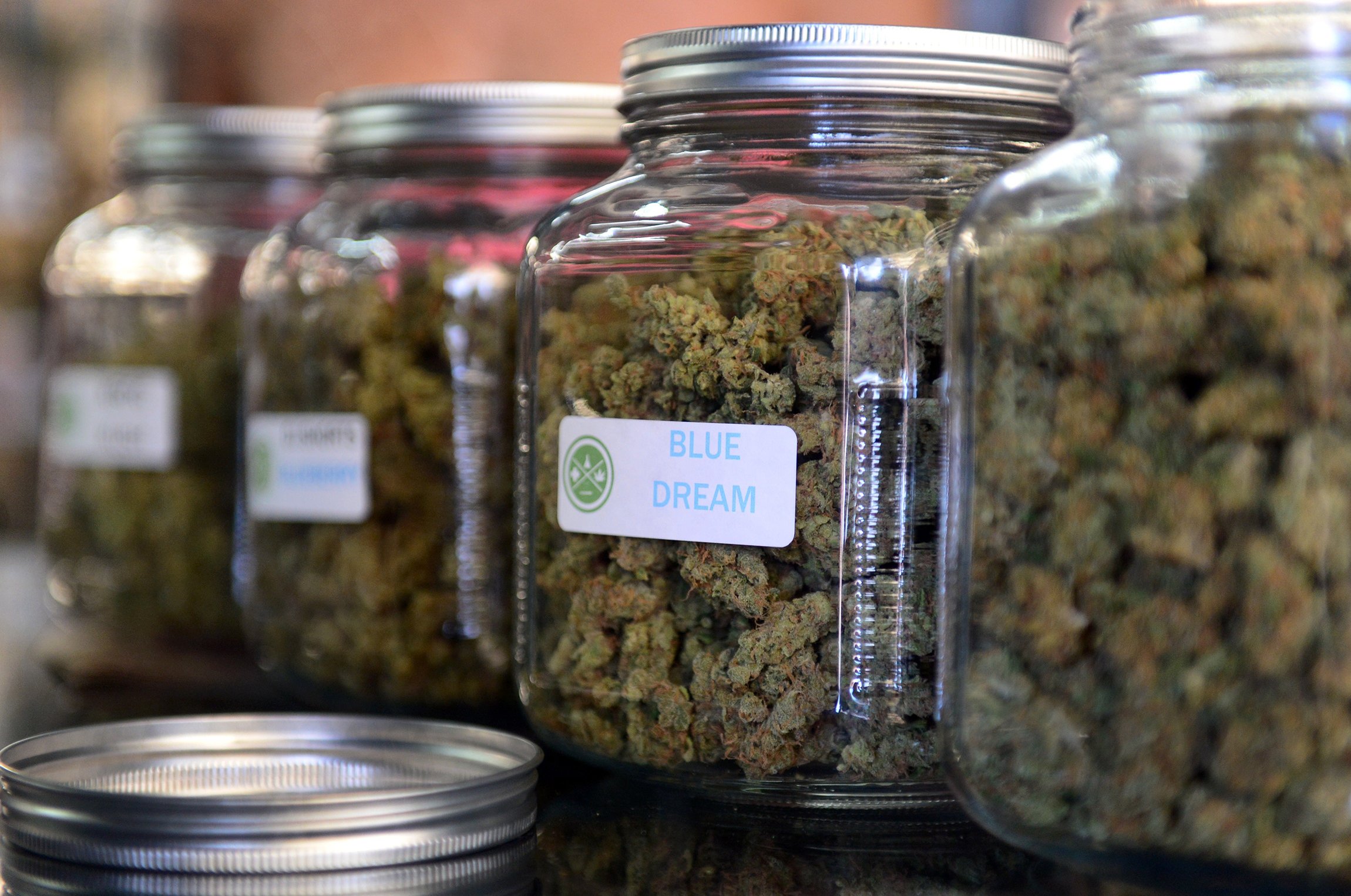 The highly-rated strain of medical marijuana 'Blue Dream' is displayed among others in glass jars at Los Angeles' first-ever cannabis farmer's market at the West Coast Collective medical marijuana dispensary, in Los Angeles, California on July 4, 2014. Photo by Frederic J. Brown/ AFP via Getty Images
 MAPS officials said in their release that the latest response by the FDA — which oversees and sets regulations for clinical trials for the development of medical products, drugs and treatments — shows a "willingness to recognize" the need for "high-quality data" that gives the public, scientists, and regulators, more information on the risks and potential benefits of a drug already used by millions. For younger generations, marijuana is already the drug of choice and has surpassed alcohol use.
"There's a huge variation of cannabis within the medicinal and commercial market," said Rodger Pinto, policy and advocacy associate for Iraq and Afghanistan Veterans of America. "One of the really interesting things about this clinical trial is that they're trying to produce the same type of availability for cannabis and potency that you can find in the commercial or state medicinal markets."
Between 2013 and 2022, the number of Americans who reported using cannabis in the past month more than doubled from 20 million to 42 million — with use also increasing among veterans, according to the Department of Veterans Affairs' National Center for PTSD. According to one study highlighted on the VA's website, in 2019, nearly one in 10 veterans in the U.S. Reported that they used marijuana in the past year.
Veteran advocacy groups have long been asking for more federal research into novel treatments for physical and behavioral health concerns to give former service members a variety of methods to heal from injuries sustained during their military careers. The VA's Office of Research and Development is currently funding 11 clinical and preclinical studies focused on the potential risks and benefits of cannabis.
Several groups told Task & Purpose that they see FDA approval for this kind of clinical study as an indicator that the federal government and in turn, the Department of Veterans Affairs, might open the floodgates for more veteran-focused cannabis research.
Patrick Murray, legislative director for the Veterans of Foreign Wars, noted that the VA has the largest health network in the U.S. And, with a "big appetite" from veterans to look at novel treatments, the department should really be leveraging its own population to study cannabis benefits, risks, treatments and outcomes.
However, Naomi Mathis, assistant national legislative director for the Disabled American Veterans said VA-led studies have been limited because FDA study restrictions and VA researchers wanted to be thoughtful about the recommendations they put out for veterans for new products like cannabis which are still not fully understood.
"What they don't want is for veterans to be guinea pigs," Mathis said, adding that with FDA approval for this MAPS study, she hopes the VA can move forward on large-scale research.
Get Task & Purpose in Your InboxSign up for Task & Purpose Today to get the latest in military news each morning, and The Pentagon Rundown for a weekly breakdown of the biggest stories every Friday.
By signing up you agree to our Terms of Service and Privacy Policy.
Vesta Anderson, a spokesperson for the Wounded Warrior Project said they believe emerging treatments for PTSD can help move veterans' medical providers from a "'one-size-fits-all approach,' which has been proven to not be effective for all, to an individualized model of care where the treatment plan is tailored to the needs of each veteran."
Despite cannabis' growing popularity, VA pharmacies cannot fill marijuana requests and VA clinicians are prohibited from prescribing it to patients, even medically, according to the department. In 2023, bills were introduced in the Senate and House to legally allow VA doctors to discuss and recommend medical marijuana programs to veterans in states where medical use is legal — something they are not allowed to do currently.
"A veteran's use of marijuana does not impact their ability to access VA health care or benefits, and veterans are encouraged to discuss any marijuana use with their VA providers," said Terrence Hayes, a spokesperson for the VA.
However, veterans like Murray with the VFW, still have trouble discussing their cannabis use with doctors because of the inconsistent patchwork of laws across the U.S. And it still being classified as a Schedule I drug. Murray said after 15 years of suffering from phantom pains after losing a limb to an IED in Fallujah, he began using a balm made of coconut oil and cannabis compounds.
"It's the only thing that has worked for me," Murray said. "If I go to either VA or I get all my care at Walter Reed through Tricare, one of them is listing me as a drug abuser."
Murray also said that being labeled as an abuser in his medical records could impact any medications he's given later on and discussions about those prescriptions.
"If I slip and break my arm tomorrow, if they need to prescribe me a narcotic, like a percocet or something, it would get flagged in the system and I may not get it without a conversation with the doctor," he said. "But also I can't speak to my doctor about what contraindications there are with this cannabis product and other medications that I may be prescribed because it's not in the formula."
It's unclear what the Trump Administration's stance on cannabis will be but there may be progress under moves made by President Joe Biden. In the last year, several agencies have taken steps to try to reclassify cannabis to a Schedule III drug which means it can be qualified for "accepted medical use" and be lawfully prescribed, according to the Congressional Research Service.
"I don't think that we'll see cannabis move forward federally without it being led by veterans," Pinto said.
The latest on Task & PurposePTSD Was Slowly Killing This York County Veteran. Special Medical Treatment Saved His Life
Your browser is not supportedfreep.Com
freep.Com wants to ensure the best experience for all of our readers, so we built our site to take advantage of the latest technology, making it faster and easier to use.
Unfortunately, your browser is not supported. Please download one of these browsers for the best experience on freep.Com
Medical Cannabis Use Alleviates PTSD Symptoms
A study published in Medical Cannabis and Cannabinoids examined cannabis use's potential therapeutic effects for patients with Post-traumatic stress disorder (PTSD). The results indicate an association between treatment with THC-predominant cannabis flower and symptomatic improvement for up to six months in a cohort of United Kingdom civilians diagnosed with PTSD. Patients reported improved quality of sleep and reduced PTSD-associated symptoms. The UK legalized the use of medical cannabis for patients who found conventional treatments unsuccessful. Roughly 4% of the UK population has PTSD,
The researchers analyzed the use of THC-dominant cannabis flower to alleviate PTSD symptoms of 58 patients with a confirmed PTSD diagnosis. The researchers analyzed data from the UK patient registry known as T21. The participants completed questionnaires that focused on patient-reported outcome measures (PROMs) reflecting health-related quality of life (HRQoL), mood/anxiety, sleep, and PTSD-specific symptoms.
The study included fifty-eight patients. Most participants were male (65.5%) and roughly 39.2 years old. Most participants had only used non-regulated or illegal cannabis (95.6%) prior to the study.
At 3 months, participants reported significant improvements in overall health, mood, and sleep quality. A majority of participants reported substantial benefits in managing intrusion symptoms, mood alterations, and reactivity alterations. None of the participants reported any side effects associated with cannabis-based medical products (CBMPs).
Data analysis showed the participants reported a 16.8-point reduction in their symptom severity scores following six months of cannabis treatment. The participants also reported significant enhancements in mood, sleep quality, and overall wellness.
The participants also reported improvements with what researchers have termed "the restored self". Participants explained that they are once again finding satisfaction in socializing and activities. They also claimed that cannabis alleviates PTSD symptoms such as anxiety and averse memories. The research team plans to conduct future studies that evaluate the long-term safety and outcomes of medical cannabis use for patients with PTSD.
Sources: Medical Cannabis and Cannabinoids, NORML


Comments
Post a Comment