Cirrhosis of the Liver: Symptoms, Stages, and Treatment


Fibromyalgia And Chronic Fatigue Syndrome: Similarities And Differences
Symptoms and clinical presentation: Fibromyalgia vs Chronic Fatigue SyndromeDiagnosis and diagnostic criteriaUnderlying causes and risk factorsTreatment and management strategiesImpact on daily life and quality of lifeConclusion ReferencesFurther reading
Fibromyalgia (FM) consists of a chronic pain syndrome, which is characterized by pain in many parts of the body, including the skin, muscles, and joints.1

Image Credit: simona pilolla 2/Shutterstock.Com
Another chronic condition called chronic fatigue syndrome (CFS), or myalgic encephalomyelitis, comprises a complex multisystem disease that is typically characterized by severe fatigue.2
Both these chronic conditions can cause difficulty in carrying out daily activities. They can be difficult to diagnose due to the lack of diagnostic tests, requiring monitoring of a patient's symptoms for a long period before determining a diagnosis.1,2
Symptoms and clinical presentation: Fibromyalgia vs Chronic Fatigue SyndromeFibromyalgia symptoms predominantly include deep muscle pain in various areas of the body, similar to the feeling of a pulled muscle or bad muscle ache. Fibromyalgia pain is unpredictable and can differ from day to day, including its severity and location in the body.1
Other symptoms can include trouble sleeping resulting in restlessness, tiredness, difficulty thinking and finding words, as well as problems with concentration known as "brain fog".1
Chronic fatigue syndrome symptoms comprise extreme fatigue, which lasts six months or longer, becomes worse with physical or mental activity, and doesn't fully improve with rest.3
CFS symptoms can differ from case to case and from day to day, and along with extreme fatigue, may also consist of problems with thinking and memory, dizziness that worsens with transitioning from a lying down or sitting position to standing, muscle or joint pain as well as having unrefreshing sleep.3
Similar and overlapping symptoms can be found in both fibromyalgia and chronic fatigue syndrome, including tiredness, cognitive dysfunction, and muscle and joint pain.3,4
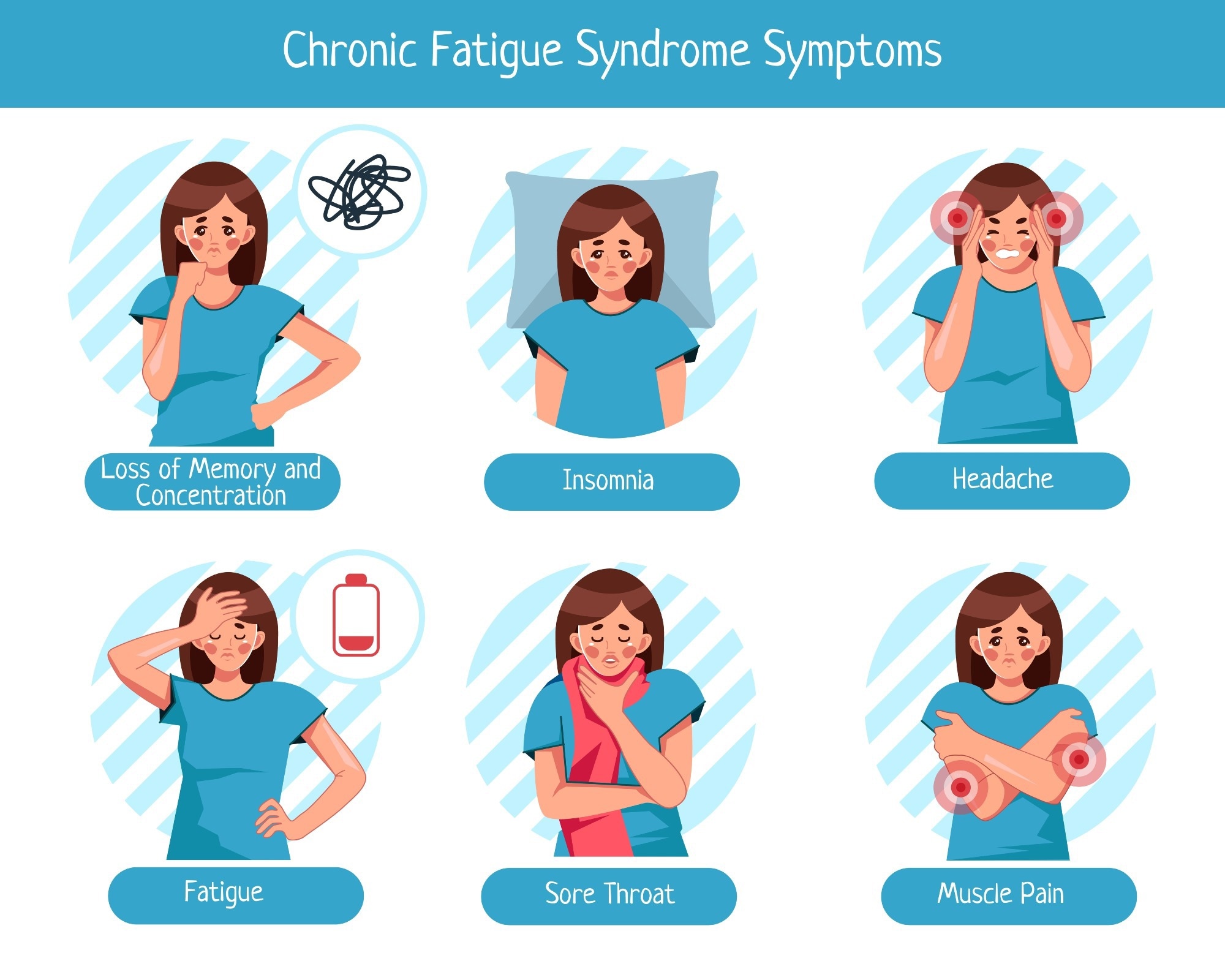
Image Credit: Lova Mikhailova/Shutterstock.Com
However, differences between FM and CFS include rest having no impact on CFS and pain being experienced in many different locations at the same time for a long period in fibromyalgia patients.1,2
Diagnosis and diagnostic criteriaA fibromyalgia diagnosis consists of pain in at least 7 out of 19 specific regions of the body for the past three months, including the chest, stomach area, back, jaw, shoulders, upper arms and forearms, hips, thighs, and calves, with both sides of the body being affected.1
Additionally, other symptoms are also required to be present for three months for a fibromyalgia diagnosis, such as difficulty concentrating, exhaustion, tiredness in the morning, stomach pain, headaches, and depression.1
On the other hand, CFS is usually diagnosed after excluding other potential etiologies. The Institute of Medicine (IOM) proposed a diagnostic criterion for CFS, which includes the presence of three or more symptoms, including (i) fatigue, (ii) post-exertional malaise, and (iii) unrefreshing sleep, for more than six months.2
What is Chronic Pain?
These symptoms are required alongside an intensity characterized as either moderate or severe for a minimum of 50% of the time, as well as one other symptom, including cognitive impairment or orthostatic intolerance.2
There are some challenges with diagnosing fibromyalgia and CFS, including a lack of diagnostic tests, which can delay a diagnosis.1
Misdiagnoses may be common for both fibromyalgia and CFS due to their symptoms being associated with other conditions, such as fatigue being linked with neurological, cardiovascular, respiratory, and gastrointestinal complaints.1,2 This can lead to laboratory tests to investigate conditions such as anemia, diabetes, or an underactive thyroid.3,4
Underlying causes and risk factorsThe cause of fibromyalgia, while not fully understood, has been hypothesized to be related to the way pain messages are processed in the brain, which can be triggered by a combination of factors, including genetic, physical, or psychological.1
Interestingly, fibromyalgia symptoms can begin after an event, such as experiencing physical trauma, infection, surgery, or even after significant psychological stress. However, some cases involve no single trigger, and symptoms accumulate over time.4
The etiology of CFS is also not fully understood by scientists and is controversial and complex, with theories about single versus multiple causes of the disorder, as well as the involvement of infections, the immune system, and genetic factors.2
There is increasing evidence that the pathogenesis of CFS may have a genetic component, with studies involving a family history of CFS or similar fatigue-related symptoms contributing to its development, while other theories include triggers such as the Epstein-Barr virus.2
How Fibromyalgia and Chronic Fatigue Are RelatedPlay
Treatment and management strategiesTreatment for fibromyalgia includes exercise and gentle sports such as cycling, which may aid in improving wellbeing, strengthening the body, and relieving some pain.1
No one treatment can alleviate all fibromyalgia symptoms. However, a range of treatments may have an accumulative impact on the disorder.4
Pain-relieving medications, including acetaminophen, ibuprofen, and naproxen sodium, can alleviate pain and improve sleep. These medications, along with antidepressants, would be helpful for pain and depression treatment for fibromyalgia and CFS.3,4
Treatment for CFS includes medication that regulates blood pressure or heart rhythms to aid with orthostatic intolerance, which counteracts the feeling of fainting or nauseousness when standing or sitting upright.3
Other more holistic and integrative approaches for managing fibromyalgia symptoms include physical therapy, with exercises that will improve strength, flexibility as well as stamina, especially water-based exercises.4
For CFS, holistic and integrative approaches include pacing for post-exertional malaise, with the aim being to remain active without over-exertion, as patients who experience this symptom struggle to find a balance between activity and rest. Tracking your activity and symptoms can also aid in determining how much activity is too much.3
Other approaches may include avoiding caffeine or having a stable bedtime routine to aid with sleep problems, while sleep apnea machines can also be used to improve sleep.3
Impact on daily life and quality of lifeWith chronic fatigue being a main feature of both fibromyalgia and CFS, this can have significant implications on daily activities and the overall wellbeing of patients.5
Patients with these chronic conditions are greatly impacted by reduced social and economic interactions, as well as reduced physical function, which is more significantly reduced than expected from sedentary living.5
If patients do not utilize effective therapies for their conditions, they will continue to experience a poor quality of life and have a higher risk of health conditions associated with inactivity.5
Coping strategies often include counseling, which may help to strengthen mental resilience with approaches to managing stressful situations.4 Additionally, support from family can be helpful as depending on the severity of these disorders, it may require substantial caregiving responsibilities, as everyday tasks may not be possible for the patients.6
The ability to successfully deal with fibromyalgia and chronic fatigue syndrome may be dependent on the family's coping skills and attitude, as a unified approach to aiding the patient with adjusting their limits and creating a stable and predictable environment with reduced stress will have a more positive effect.6
Contacting your healthcare provider to aid in dealing with FM or CFS can be helpful as well as they can provide resources that may help the patient and caregiver cope with their condition more effectively.3,4
ConclusionBoth fibromyalgia and chronic fatigue syndrome are chronic conditions that can impact the quality of life of sufferers. With no diagnostic test and no cure, they can be difficult to manage.1,2
These disorders are not fully understood; however, continued research and awareness can aid in earlier diagnoses and better treatment management, enabling patients to improve their quality of life.1,2
A 2022 study reported that the most effective way to improve cardiorespiratory fitness, as well as muscle mass and function, is by regular, intense exercise. Interestingly, future studies may investigate whether regular, intense exercise familiarizes patients with afferent signals from exercising limbs to improve exercise tolerance by reducing their increased sensitivity to effort and fatigue.5
Patients who experience relevant symptoms for more than a couple of months should seek support and professional guidance to manage their pain and fatigue more effectively.3,4
ReferencesInformedHealth.Org [Internet]. Overview: Fibromyalgia. Institute for Quality and Efficiency in Health Care (IQWiG). 2006. [Updated 2022 May 24]. Available from: https://www.Ncbi.Nlm.Nih.Gov/books/NBK492993/
Sapra A, Bhandari P. Chronic Fatigue Syndrome. StatPearls [Internet]. [Updated 2023 Jun 21]. Available from: https://www.Ncbi.Nlm.Nih.Gov/books/NBK557676/
Chronic Lyme Disease -- Complications
With treatment and time, the symptoms of Lyme disease, which is caused by a tick bite, usually get better. If you are diagnosed with Lyme disease, you're usually given antibiotics for 2-4 weeks. When symptoms linger well beyond the typical treatment time, you may have what's called "post-treatment Lyme disease syndrome" (PTLDS). It's also called "chronic Lyme disease." About 1 in 10 people who get Lyme disease have lingering symptoms.
A wide range of effects from PTLDS can go on for months. Some call Lyme disease "the great imitator" because its symptoms tend to mimic many other problems.
Fatigue
The hallmark problem of PTLDS is feeling tired. This often goes along with widespread muscle aches and severe headaches. The fatigue can linger for years. The symptoms are similar to those of chronic fatigue syndrome or the pain condition called fibromyalgia.
Arthritis and Joint Pain
At least half of people with Lyme disease get a form of arthritis. Often the pain and joint stiffness can be felt all over, but sometimes it's just in certain joints, like the knees. It usually goes away, but in some people, the arthritis may continue.
Head Problems
Many people with PTLDS have bad headaches and complain of trouble with short-term memory and other thinking skills.
Numbness
Tingling, shooting pain, or loss of feeling may strike in the arms, face, hands, or legs.
Bell's Palsy
When chronic Lyme disease affects the nerves in the face, you may get what's called Bell's palsy. The face muscles and eyelid droop on one side. Your face may feel numb. Hearing or vision can also be affected.
Heart Problems
Rarely, PTLDS can cause organ damage. The heart may beat irregularly or too slowly.
Depression and Stress
Lyme disease itself doesn't make people depressed. But coping with symptoms that persist long after treatment ends can be hard. That can cause stress, anxiety, and depression. Talking to a counselor may give needed extra support through this stressful time.
When Lyme disease symptoms don't go away after treatment ends, sometimes another round of antibiotics is given. Studies show little difference between those who got extra drugs compared to those who didn't.
Talk to your doctor about all of your symptoms. Together, you can come up with a plan to treat them.
Patients Say Healthy Gut Bacteria Relieved Their Chronic Pain In A Puzzling Disease
Imagine waking up every day after a full night's sleep feeling completely fatigued. Every muscle hurts. But you don't have a fever or an infection. After years of diagnosis, doctors can't tell you why the pain keeps growing. Painkillers offer little help. Eventually, you can no longer walk—and still, there's no explanation.
That's the story of Rina Green who has fibromyalgia, a mysterious condition that affects roughly four percent of the population, mostly women. Its symptoms are varied. Most people experience chronic debilitating pain, fatigue, sleep disruptions, and brain fog. Over time, nearly half develop depression. The pain can be so severe that, like Green, they can no longer walk or take part in daily activities.
Unlike a paper cut or scraped knee, fibromyalgia isn't linked to obvious damage to tissues or organs. The condition was once believed to be just in patients' heads. More recent studies, however, have found signs of dysfunctional nerve connections and inflammation throughout the nervous system in people with the disease. Their immune systems are out of whack, and so are their gut microbiomes—the collections of bacteria living in our digestive systems.
A new study in Neuron now suggests that the gut microbiome may be key to treating the disease. In a small clinical trial, 14 women with severe fibromyalgia took pills containing healthy, living gut bacteria from donors. Within a month, nearly all reported decreased pain. Green, now 38 years old, was able to leave her wheelchair and take short walks.
The results are the latest to highlight a connection between gut bacteria and the brain. Tinkering with this connection—through probiotics, for example—may offer a way to tackle chronic pain without directly accessing the brain using opioids or other painkillers.
A Microbe UniverseWe're more microbe than human. A recent estimate suggests we carry three times more bacterial cells than human ones. They're not just along for the ride. Over the past decade, scientists have linked various health outcomes to the mixture of microbes in the gut.
Some are tied to the brain. Called the gut-brain axis, scientists have shown that gut bugs can influence anxiety, depression, and memory depending on which chemicals they release. These might diffuse into the blood or zap nerves and send signals to the brain.
Older studies found people with depression or other brain disorders have altered gut microbiomes. Because microbes live synergistically with us, they pump out different chemicals—some of which impact the brain, depending on their type and abundance. Some researchers are hunting down these chemicals as they relate to mental health or antibiotic-resistant gut problems. Others are taking a simpler approach: Replacing "dangerous" bacteria with helpful bugs from healthy donors through a procedure called fecal microbiota transplant.
The strategy has been used to treat irritable bowel syndrome, antibiotic-resistant infections, and pain related to chemotherapy. More trials are testing if it can boost cancer immunotherapies.
In 2019, study author Amir Minerbi, director of the Pain Medicine Institute at the Rambam Health Campus in Israel, and colleagues found that the gut microbiome shifted in women with fibromyalgia. Comparing the microbiomes of 77 women with the condition to 79 without, they used AI to highlight signatures related to the disorder.
This led the team to wonder: Do altered microbiomes trigger chronic pain?
Mediator of PainIn the new study, the team first transplanted gut bacteria from women with or without fibromyalgia into mice. The animals had their microbiomes wiped out, allowing the new arrivals to settle.
In just a month, those receiving microbes from donors with fibromyalgia began experiencing similar symptoms. They were more sensitive to pain from pressure, cold, and heat. The mice also seemed to feel pain without stimulation. But their health was mostly intact otherwise.
The picture changed at four months. The animals began showing signs of depression similar to their donors. Their nerve signals also changed over time, pumping out excessive neuroactive chemicals that amp up data transmission—which could contribute to increased sensitivity to pain—and their immune systems shifted towards a more inflammatory response.
These symptoms were treatable with a two-step program. First, the team dosed the mice with antibiotics to wipe out "bad" gut bugs. Next, they transplanted microbes from healthy donors into their guts. The treated mice were perkier, with nearly normal sensitivity to pain.
Encouraged by the results, the team recruited 14 roughly middle-aged women with severe fibromyalgia. Despite taking at least two painkillers and undergoing lifestyle tutoring, all participants still struggled with excruciating pain and daily fatigue.
After purging gut bacteria with antibiotics, each participant received five microbiome transplants from healthy donors, once every two weeks, in the form of a pill.
The new bugs took hold inside their guts roughly a month after the first treatment. One week after the last treatment, 12 people reported less pain associated with cold or heat. They felt less anxious or depressed, and most were finally able to get a good night's sleep.
"These findings are really impressive," Andreas Goebel at the University of Liverpool, who was not involved in the work, told Nature.
Next StepsThough promising, the study has its limits.
For one, it's open-labeled, meaning both researchers and patients knew they were getting the treatment. That means placebo effects could be a factor in why they felt less pain. The study also only included women and female mice. The reason for this, explained the team, is that fibromyalgia predominately affects women. But the results pave the way for the approach to be studied in a larger, more diverse group of people.
The team is planning a randomized controlled clinical trial—the gold standard—in roughly 80 people. They're also hoping to pin down specific bacterial species and environmental factors involved in pain, such as stress, infections, and other diseases. And they're investigating several molecules and signaling patterns discovered in the study that differ in people with fibromyalgia.
For now, we can say "altered gut microbiota has a role in fibromyalgia pain, highlighting it as a promising target for therapeutic interventions," wrote the team.


Comments
Post a Comment