Obesity Phenotypes, Diabetes, and Cardiovascular Diseases


Left Anterior Fascicular Block Diagnosis Causes Alarm
Dr. Keith Roach
DEAR DR. ROACH: I am a 66-year-old woman who recently had an ECG prior to my knee surgery. The interpretation I received stated that I had an abnormal ECG with a "left anterior fascicular block." Needless to say, this alarmed me. I saw a nurse practitioner who stated: "Don't be concerned by the language; your doctor viewed the ECG and said it was fine." Your thoughts, please? — M.M.
ANSWER: Anytime a person hears that there is a problem with their heart, it causes concern, so I understand why you were unsatisfied with an answer that doesn't explain what your condition really is.
The heart is a wonderful pump, but when the pump function is bad, it is called heart failure. The heart has arteries that provide it with blood, containing the oxygen and fuel the heart needs, and when the arteries are blocked, it is called coronary artery disease, which can lead to heart attack. But the heart also has an electrical supply, with a natural pacemaker and specialized cells that act like wires, called the bundle branches (two of them, right and left), which in turn give rise to smaller divisions called fascicles (the left bundle branch has two fascicles; the left anterior and left posterior fascicles).
Just like in a bundle of wires, electrical transmission through the fascicles and the bundle branches can be blocked. This is quite common as people age. The blockage causes delays in conduction through the heart, which can be seen on the electrocardiogram. But, it seldom causes any symptoms. In people who otherwise have no heart disease, the presence of left anterior fascicular block (also called left anterior hemiblock) does not increase the risk of heart attack or the need for a pacemaker (although there is a small increased risk in the development of atrial fibrillation, a common abnormal heart rhythm).
People like you, with only left anterior fascicular block, also are not likely to develop additional blocks, but if multiple conducting pathways do become blocked, a pacemaker is often put in. Without any conducting system, the heart will beat at a dangerously slow rate.
You should let your doctor know if you notice fast or irregular heartbeats or of any new symptoms such as shortness of breath.
DEAR DR. ROACH: What causes the breasts to act like they have a heartbeat? It happens to me any time, any place. Is there a problem? — L.B.
ANSWER: The breasts are, of course, directly over the heart, and when a person is lying down, both men and women may see the chest move with the pulse. This is especially true in people with forceful heartbeats, such as those after exercise. It is very likely that you are seeing your normal heartbeat transmitted through your breast tissue.
There are certain unusual and rare heart conditions that can cause the heart to beat more forcefully, such as a leaky valve that lets the blood back into the heart after the heart pumps the blood into the aorta. This makes the heart work extra hard.
A careful physical exam by your doctor would be enough to make sure you don't have one of these worrisome conditions.
* * *
Dr. Roach regrets that he is unable to answer individual letters, but will incorporate them in the column whenever possible. Readers may email questions to ToYourGoodHealth@med.Cornell.Edu or send mail to 628 Virginia Dr., Orlando, FL 32803.
Dear Doctor: What Causes The Breasts To Act Like They Have A Heartbeat?
DEAR DR. ROACH: What causes the breasts to act like they have a heartbeat? It happens to me any time, any place. Is there a problem? -- L.B.
ANSWER: The breasts are, of course, directly over the heart, and when a person is lying down, both men and women may see the chest move with the pulse. This is especially true in people with forceful heartbeats, such as those after exercise. It is very likely that you are seeing your normal heartbeat transmitted through your breast tissue.
There are certain unusual and rare heart conditions that can cause the heart to beat more forcefully, such as a leaky valve that lets the blood back into the heart after the heart pumps the blood into the aorta. This makes the heart work extra hard.
A careful physical exam by your doctor would be enough to make sure you don't have one of these worrisome conditions.
DEAR DR. ROACH: I am a 66-year-old woman who recently had an ECG prior to my knee surgery. The interpretation I received stated that I had an abnormal ECG with a "left anterior fascicular block." Needless to say, this alarmed me. I saw a nurse practitioner who stated: "Don't be concerned by the language; your doctor viewed the ECG and said it was fine." Your thoughts, please? -- M.M.
ANSWER: Anytime a person hears that there is a problem with their heart, it causes concern, so I understand why you were unsatisfied with an answer that doesn't explain what your condition really is.
The heart is a wonderful pump, but when the pump function is bad, it is called heart failure. The heart has arteries that provide it with blood, containing the oxygen and fuel the heart needs, and when the arteries are blocked, it is called coronary artery disease, which can lead to heart attack. But the heart also has an electrical supply, with a natural pacemaker and specialized cells that act like wires, called the bundle branches (two of them, right and left), which in turn give rise to smaller divisions called fascicles (the left bundle branch has two fascicles; the left anterior and left posterior fascicles).
Just like in a bundle of wires, electrical transmission through the fascicles and the bundle branches can be blocked. This is quite common as people age. The blockage causes delays in conduction through the heart, which can be seen on the electrocardiogram. But, it seldom causes any symptoms. In people who otherwise have no heart disease, the presence of left anterior fascicular block (also called left anterior hemiblock) does not increase the risk of heart attack or the need for a pacemaker (although there is a small increased risk in the development of atrial fibrillation, a common abnormal heart rhythm).
People like you, with only left anterior fascicular block, also are not likely to develop additional blocks, but if multiple conducting pathways do become blocked, a pacemaker is often put in. Without any conducting system, the heart will beat at a dangerously slow rate.
You should let your doctor know if you notice fast or irregular heartbeats or of any new symptoms such as shortness of breath.
Dr. Roach regrets that he is unable to answer individual letters, but will incorporate them in the column whenever possible. Readers may email questions to ToYourGoodHealth@med.Cornell.Edu or send mail to 628 Virginia Dr., Orlando, FL 32803.
(c) 2022 North America Syndicate Inc.
All Rights Reserved
If you purchase a product or register for an account through a link on our site, we may receive compensation. By using this site, you consent to our User Agreement and agree that your clicks, interactions, and personal information may be collected, recorded, and/or stored by us and social media and other third-party partners in accordance with our Privacy Policy.
Left Anterior Fascicular Block: Who Cares?
April 27, 2017
1 min read
Add topic to email alerts
Receive an email when new articles are posted on
Please provide your email address to receive an email when new articles are posted on . Subscribe We were unable to process your request. Please try again later. If you continue to have this issue please contact customerservice@slackinc.Com.Back to Healio
We see this all the time: A routine ECG shows a left anterior fascicular block (also known as LAFB or left anterior hemiblock). Who cares? Does this mean anything, and is it any cause for concern? Let's take a look.
LAFB occurs when the anterior fascicle of the left bundle branch can no longer conduct action potentials. Review how to diagnose this on an ECG here.

Steven Lome
Here is what it looks like:
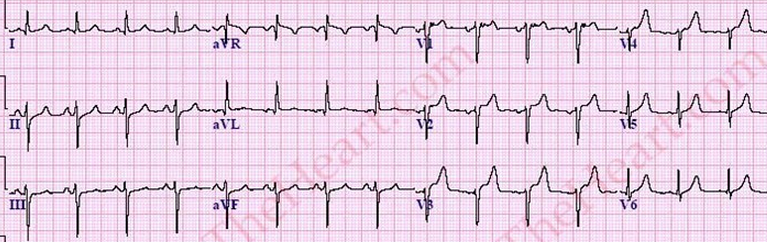
The LAFB itself does not cause any symptoms. If action potentials do not go through the normal LAFB to the left ventricular myocardium to induce contraction of the heart muscle cells, then the action potentials will eventually get there by traveling through the posterior fascicle and right bundle branch. They will ultimately reach the muscle cells that the left anterior fascicle normally supplies by spreading electrical activity slowly from myocyte to myocyte through "intercolated disks."
The question is, does LAFB signal a heart problem that we need to worry about? Maybe and maybe not.
Some LAFBs are a result of age-related conduction system disease, aka Lev's disease. Others are, indeed, from structural heart problems. These can include coronary artery disease, prior myocardial infarction, left ventricular hypertrophy from hypertensive heart disease, cardiomyopathies or valvular heart disease.
Having said all that, in the absence of any symptoms suggestive of heart disease, no testing needs to be done just because LAFB is seen on the ECG. Nevertheless, LAFB is not often a "normal variant," so have a low threshold for cardiac testing if potential heart disease symptoms are present.
Therefore, we shouldn't simply ignore the LAFB seen on ECG, but at the same time there is no need to call 911.
Editor's note: This Blog was originally published on learntheheart.Com.
Sources/DisclosuresCollapse Source: Lome is a cardiologist at the Community Hospital of the Monterey Peninsula. Disclosures: Lome reports no relevant financial disclosures.Add topic to email alerts
Receive an email when new articles are posted on
Please provide your email address to receive an email when new articles are posted on . Subscribe We were unable to process your request. Please try again later. If you continue to have this issue please contact customerservice@slackinc.Com.Back to Healio


Comments
Post a Comment